
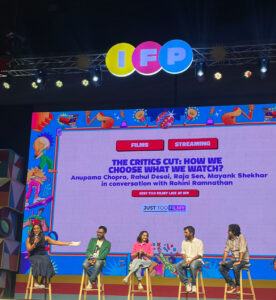
There are some sessions you walk into with simple expectations. You assume you’ll hear opinions about films, maybe learn how critics choose what to watch. But then there are sessions like The Critics Cut at IFP, which quietly shift how you see the entire act of reviewing. This panel was less about films and more about the responsibility that comes with having a voice in a world where everyone has an opinion. As someone who reads, reviews and reflects on stories, this discussion felt like a gentle reset.
A note on Rohini’s moderation
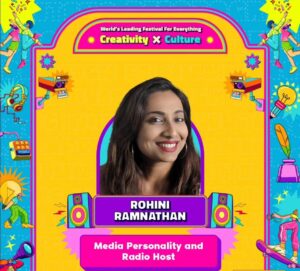
Even before the critics shared their perspectives, it was clear that the conversation was in capable hands. Rohini Ramnathan guided the session with clarity, warmth and intention. She asked questions that drew out meaningful insights and ensured that every panelist had space to contribute without overshadowing one another. During the audience interaction, she took questions from different parts of the room rather than the easiest hands in front. Her balance, pace and presence elevated the entire panel. I have attended many discussions over the years, but her moderation stood out as particularly thoughtful and inspiring. She is someone I would genuinely love to meet someday and thank.
What critics actually do behind the scenes
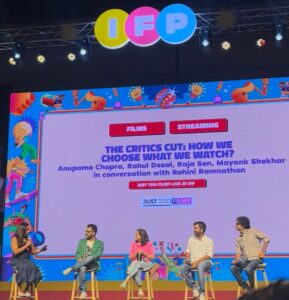
The first theme that emerged was the gap between what critics watch and what they eventually write about.
Raja Sen reflected on how critics often consume far more than they choose to discuss publicly. The value of a review lies not in covering everything but in choosing the work that opens up a meaningful conversation.
Anupama Chopra spoke about the emotional weight of reviewing. Years of someone’s effort sit behind every film, yet critics must still remain honest and clear. She shared how being truthful can sometimes hurt feelings, but integrity has to outweigh discomfort.
Rahul Desai added a layer of craft to the discussion. His lens emphasized the importance of adapting tone across mediums. Reviewing a series, a film or a short are not identical tasks. They require shifts in writing, expression and pace. Listening to him reminded me that the review itself is a piece of writing. It deserves as much care as the art it is responding to.
Mayank Shekhar explained how widespread opinions have become, but opinions are not the same as perspective. The difference between a casual reaction and a thoughtful critique is the depth of understanding behind it. This is one of the most important lessons for reviewers today.
The rise of casual negativity
The panel spent some time addressing what people often call hate watching. This is the act of consuming something purely to mock it or react negatively to it. One of the critics pointed out that this habit has become woven into online culture, but it contributes very little. Critics who take their craft seriously do not spend their time on content that does not deserve attention.
This reminded me of what we have seen in the book world recently. Several books faced backlash even before their release. A few known personalities published books this year, and the internet reacted more to the fame of the author than to the writing itself. Outrage became a strategy for visibility. Many jumped into the conversation without reading the book fully because negativity performs well online. This session made it clear that reviews shaped by the desire to go viral are not really reviews. They are content disguised as critique.
Another concern raised in the panel was the reduction of art into small, meme-like fragments. When everything becomes a joke, nuance disappears. Films and books lose their layers when they are discussed only in the form of short trending reactions.
When the algorithm becomes the critic
Mayank Shekhar pointed out how social media encourages extreme reactions. The algorithm pushes people toward hit lists or trash lists because nuance does not travel as quickly. His reflection that certain films perform far better on short-form platforms like reels made me think about how platform dynamics can distort the value of a story.
The same is true for books. Some titles trend because they photograph well, not because they are well written. When reviewers start creating for the algorithm instead of for the reader, they lose the depth and honesty that criticism requires.
Critics as cultural historians
Rahul Desai described criticism as a form of documentation. Reviewers are not only responding to the present. They are unconsciously archiving the cultural landscape for future readers. This idea expanded the responsibility reviewers carry. Every review becomes a trace of what a particular era valued. It reaffirmed for me that reviewing is not just commentary. It is cultural memory.
Critics also spoke about the courage required to call out issues honestly, especially when egos or backlash are involved. A review without honesty has little long term value.
The Critical Vocabulary I Walked Away With
This panel brought up several terms that helped me understand criticism more clearly. These concepts added depth to how I think about reviewing across mediums.
Hatewatch
Engaging with a film or show purely to criticise or mock it for entertainment or content.
Memeification
Reducing a complex work into small meme-like reactions that flatten its nuance.
Gatekeeping
Controlling or influencing what content or creators gain mainstream visibility.
Perspective
The deeper context and understanding a critic brings that goes beyond personal preference.
Algorithm
The system that shapes which opinions and forms of content trend online.
Accessibility
The ability to explain ideas clearly without oversimplifying them.
Integrity
A reviewer’s commitment to fairness, accuracy and honesty even under pressure.
Virality
The rapid spread of content driven by emotion or trends rather than quality.
Pure gold takeaways from The Critics Cut
Some lines and ideas from the panel stayed with me long after the session ended. These are not direct quotes but interpretations of the strongest thoughts shared.
1. Some stories find greater traction on short-form platforms than they do in long-form viewing.
A reminder that attention is shaped by platforms as much as it is by narrative.
2. Opinions are everywhere. What sets a reviewer apart is perspective.
A clear distinction between reacting and understanding.
3. Outrage travels faster than nuance, which is why reviewers must guard against easy negativity.
Negativity is tempting, but it rarely builds meaningful conversations.
4. Reviewers document culture for future generations.
A powerful reminder of the long term value of honesty.
5. When art is reduced to memes, its depth is lost in the process.
Stories deserve attention, not only reactions.
6. Honesty can create discomfort but it is essential for criticism to remain meaningful.
Responsibility cannot always be comfortable.
7. Balanced reviews may not be viral, but they are trustworthy.
Long term credibility outweighs short term metrics.
8. A thoughtful review begins with choosing the right stories to engage with.
Curate intentionally rather than reacting widely.
9. A reviewer’s tone can shift across formats, but their integrity must stay consistent.
Mediums change, values should not.
10. Criticism works best when it aims to build better conversations, not louder reactions.
The purpose is clarity, not noise.
What book bloggers and reviewers can learn from film criticism
This session offered several insights that apply directly to anyone who reviews books or stories.
Curate instead of reacting to everything
Not every book needs a review. Choose work that deserves deeper reflection.
Develop a strong perspective
Your lens is more important than your immediate reaction.
Avoid hate reviewing
Criticism built on negativity may perform well online but holds very little value.
Treat your reviews as writing
Your craft matters as much as the book you are reviewing.
Resist the pull of trends
Virality is not the same as value.
Critique with empathy
Be honest without being dismissive. Every story carries effort and intention.
Remember you are documenting literary culture
Your reviews are part of a wider record. They deserve care, clarity and responsibility.
My personal takeaway
This session reminded me that criticism is not about being the loudest voice or the first to react. It is about engaging with stories thoughtfully. It is about understanding before judging. It is about choosing honesty even when it feels risky.
As a creator, reader and reviewer, I left the panel feeling more grounded in how I want to approach my own work. The Critics Cut did not just make me rethink film criticism. It reshaped how I think about all forms of reviewing.
This blog post is part of ‘Blogaberry Dazzle’
hosted by Cindy D’Silva and Noor Anand Chawla.
It is so important for us bloggers to understand the fine line between constructive criticism and just ranting, so those insights really stood out to me. I love that you highlighted how valid blogging is as a medium because it often feels like we aren’t taken as seriously as traditional media.
This is a keen observation of a Critics session, Sameeksha. I am pleasantly surprised by how you brought out so many takeaways from the session for reviewing. It is a tough job, and one has to be neutral and know the trade to be able to criticise. Hatewatch is a new term, I learnt, and memeification stems from the word meme, which I am familiar with, but the meaning here is different.
Your post is a masterclass of how to critique right. Thank you for sharing important takeaways with us, Sameeksha.
Healthy Criticism helps in becoming better but criticism to make feel people low is something I never ever appreciate. Criticism is an art which very few actually knows.
That sounded like a good panel discussion. Personally, I don’t do negative reviews, though I do politely express what I liked or didn’t. On the commercial cinema scale in Bollywood, most movies have taken short cuts. In Hollywood, the edits are better and the direction far more practical, but like you say, its depth and understanding that brings out the USP of the reviewer, along with integrity.
This really made me think about how reviewers and bloggers shape what we end up watching or reading and why it matters to stay honest and true to your own voice.
I think The Critics Cut at IFP was a great brainstorming and learning exercise for all who attended and contributed.Your takeaways fuel my thoughts too as a film and books reviewer , how different mediums need different approaches and how important it is to have a perspective and not be swayed by trends.
The Critics Cut at IFP felt less like a panel and more like a reminder of responsibility. It reaffirmed that reviewing isn’t about reacting fast or performing outrage, but about bringing perspective, care, and honesty to conversations around art. In a time when algorithms reward noise, this session quietly defended nuance. What stayed with me most was the idea that critics are cultural historians—documenting not just stories, but the values of an era. The discussion challenged the rise of hate-watching, meme-led criticism, and virality-driven opinions, urging reviewers to curate intentionally and write with integrity. For me , I would have walked away more conscious of my own voice as a reviewer—choosing depth over speed, clarity over cleverness, and responsibility over reach.
Really interesting read on why a critics’ cut at IFP matters for reviewers and bloggers. Love that it gives space to thoughtful voices and not just noise. Makes you feel seen if you’ve ever done a long review and wondered if anyone was actually listening.
Thank you, Sameeksha. Those are indeed nuggets of wisdom. As someone who writes and reviews books, this post gave me a lot of insight, and I will certainly be more mindful when I review in the future.
I can’t do justice to this post this month. So saving it for a more leisure read!
Thanks for sharing snippets form the session. This is indeed useful. I also learnt some new terms
Your reflection on The Critics Cut at IFP really made me rethink how I approach reviews as a blogger, especially the ideas about depth over instant reactions and honest engagement with stories, and I loved how you connected the session’s lessons to reviewing with purpose.
Thoughtful critique, integrity, and perspective matter more than virality. As a blogger, it’s a reminder to prioritize depth, honesty, and cultural documentation over speed, trends, or superficial reactions.