
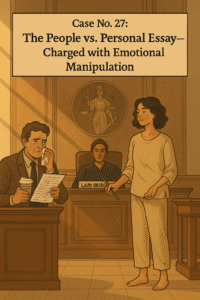
Case No. 27: The People vs. Personal Essay — Charged with Emotional Manipulation
Tagline: “Truth is allowed its metaphors, as long as it confesses by the end.”
Courtroom Setting
The courtroom smells faintly of old notebooks and unprocessed feelings.
At the bench sits Lady Objectivity, unimpressed by drama but curious about its staying power.
On the left, Mr. Reader — eyes slightly red, clutching tissues like evidence.
And in the center, the defendant: The Personal Essay, barefoot, vulnerable, wearing thick glasses and emotional transparency like armor.
The charge?
Emotional Manipulation.
The crime?
Making readers cry too easily and then making them wonder if they’ve been played.
Exhibit A: The Prosecution
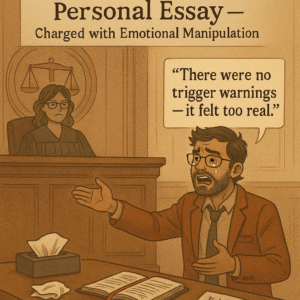
Mr. Reader rises, voice trembling.
“Your Honor, there were no trigger warnings. None.
The essay felt too real.
It made me remember things I didn’t want to,
opened doors to memories I had locked away.
I came for words, not wounds.”
The jury shifts uneasily. Every one of them has a favorite essay they still can’t reread.
Exhibit B: The Defense
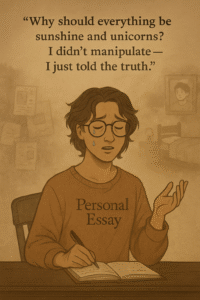
The Personal Essay stands, clutching its notebook like a heart.
“I connected because I resonated.
Why should everything be sunshine and unicorns?
Sometimes reality is darker but acceptance matters.
I didn’t manipulate anyone. I just told the truth.
And sometimes truth hurts more than fiction ever could.”
Its voice shakes, but the sincerity in it softens the room.
Even Lady Objectivity blinks slowly, almost emotionally.
Exhibit C: The Witnesses
Memory takes the stand first.

Fidgety. Forgetful. Honest in fragments.
“I remember the pain, Your Honor, but words changed it.
They made it louder. Sharper.
Maybe it wasn’t manipulation, maybe it was magnification.
Writing didn’t lie. It just made the scar look new again.”
The court murmurs in quiet recognition.
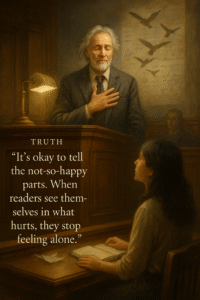
Then comes Truth, the most overworked witness of them all.
Exhausted but unwavering.
“I get tired, yes.
But it’s necessary to tell things as they are not as people wish they were.
Reality isn’t always kind, but it’s collective.
When readers see themselves in what hurts, they stop feeling alone.
That’s not manipulation. That’s connection.”
Lady Objectivity puts down her pen for the first time.
Even she can’t refute that.
The Final Verdict

The courtroom waits.
Lady Objectivity clears her throat.
“This court finds that Truth and Art can and must coexist.
Fiction may offer escape, but truth offers perspective.
Both are necessary, one to rest the heart,
the other to remind it to keep beating.
The Personal Essay is hereby found guilty… but poetically so.
Because reality, however raw, is not just a mirror to society,
it is a mirror to self.
And truth, Your Honor, cannot be escaped.”
The gavel lands softly, once, twice.
Somewhere in the gallery, a writer wipes their tears and whispers, “I’m going to write about this.”
This post is a part of Blogchatter Half Marathon 2025
“This post is a part of ‘Real and Rhythm Blog Hop’ hosted by Manali Desai and Sukaina Majeed under #EveryConversationMatters blog hop series “
Loved how you turned essays into a courtroom drama—brilliant framing! The way you explore the emotional pull of personal writing and ask whether it’s authentic or manipulative is so thought-provoking. Thanks for making me rethink what it means to wear one’s heart on a page.
Thank you so much for your kind words!
I absolutely loved how your post flipped the usual personal-essay paradigm by putting the essay itself in the dock, very clever, playful, and yet so piercing in its honesty. I found myself nodding in recognition when you described the essay making us open doors to memories we’d slammed shut – brilliantly done. The idea that emotional honesty might be accused of “manipulation” is provocative and made me rethink how I consume (and write) personal work. Your opinion/words are confident, warm and unafraid to ask real questions about vulnerability and truth. Your post stirred me, challenged me, and left me thinking long after I hit “read”. #RealandRhythmBlogHop
Thank you for your kind appreciating words.
A mirror to self. That’s so important. And I feel that’s the beauty of personal essays. They’re so many times about something deep and personal that the writer is now ready to share with the world.
A great idea to put the ‘Personal essay’ in the dock with clever usage of the exhibits. Resonating with the essay is cathartic for the readers, definitely, adding strength to your perspective. The verdict by none other than Lady Objectivity – ‘guilty but poetic’ is the cherry on top!
To be honest, I’ve discovered the joy of reading (and writing) personal, reflective essays very recently. And I love it mainly for its good storytelling and relatability. When it feels real.
Your post is very creative.
I am really enjoying this court room series. The verdict always leaves you content and you cannot argue further. “The Personal Essay is hereby found guilty… but poetically so.
Because reality, however raw, is not just a mirror to society,
it is a mirror to self” Loved how beautifully you captured the essence!
Chosen a great theme for this very creative piece of courtroom drama, putting personal assay into the dock and bringing truth and memory as the witnesses. I personally prefer Personal essays but they can be hard hitting.
Wow… I’m a big cotradictor of content warnings and a big believer of facing your triggers to overcome them – after all, it’s just fiction, it’s not happening to you. You must maintain that distance.
Well written! Keep it up!
What a brilliant court scene you played out here! Truth and Fiction both need to co-exist, and the personal essay can dredge up old, painful memories. But that is the beauty of writing, which hurts even as it heals. A wonderful post, thank you, Sameeksha!
Very creative approach to the personal essay’s conundrums. Truth isn’t quite palatable in most situations. I’m sure I have hurt quite a few souls with my personal narratives.
“Reality isn’t always kind, but it’s collective.
When readers see themselves in what hurts, they stop feeling alone.
That’s not manipulation. That’s connection.”
I loved this sentence of yours.
This was an innovative and different take fiction versus personal essays. I think both are important in their own ways. Personal essays can raise uncomfortable questions, but then, I think that too is very important for change.
Loved this courtroom drama. I too was never a fan of essays, I used to find them too real.
Your writing is deep and makes one think. The courtroom scene is vivid, and the characters feel real. You explore big themes like truth and emotions in a way that feels honest.
Interesting take with the courtroom drama. I read very few personal essays and I’m not sure why. Though I write a lot of personal experiences online. Perhaps I’m only a writer and not a reader of too many non-fiction writings.
This felt like a gentle nudge to the heart — honest, raw, and quietly profound.
If this is emotional manipulation, I’ll take it.
It reminded me of the truths I keep tucked away… and why they still matter.
Truth is bitter but stronger than fiction. You case 27 has strongly portrayed the various arguments and truth will always come out on the top!
Truth will always prevail, no matter how harsh it may be—enjoyed reading your courtroom drama.
Your post is creatively unique & I loved how you have engaged the reader with your brilliant storytelling technique. “The Personal Essay is hereby found guilty… but poetically so. This line hit so hard.
A fabulous idea of jotting down a personal essay in the courtroom style. The defence and prosecution were so convincing in the most poetic way, but what sealed the deal was the verdict; “Fiction may offer escape, but truth offers perspective.
Both are necessary, one to rest the heart,
the other to remind it to keep beating.”, what powerful words.
Lady Objectivity has a point. One cannot sugar coat truth even if it makes one uncomfortable. It has to feel real. The connection with readers only enhances it’s relatability.
This is such a brilliant and creative take, a courtroom drama for personal essays! You cleverly got me hooked throughout.
I love how you turned a reader’s inner turmoil into a courtroom drama, making truth feel both guilty and necessary. It’s personal, witty, and beautifully resonant.
This made me really question whether raw emotional writing is cathartic truth or emotional manipulation.
We tend to forget that heavy writing can hurt, but sometimes that hurt is necessary, because it forces us to look at parts of ourselves we’d rather ignore
Wow. I love the metaphor of challenging the ethics of the personal essay. The witnesses, Memory and Truth – brilliant choice. The final verdict is very thoughtful.
I love the presentation, Sameeksha; you make it look so real. And indeed, personal essays touch the raw nerve, and why not? Truth said in any way is relatable, no doubt, but also hurts…isn’t that why it is truth?
Loving the metaphors here. Since I started writing seriously, I have been in love with personal essays more than fiction. Guilty as charged!
written in such a poetic manner. reminded me of my ideological belief that you cannot separate art from the artist