
19 Rules of Happy Relationship Review | A Realistic Take on Love & Compatibility
19 Rules of Happy Relationship Review
Author : Debotosh Chatterjee, IRS
Book Reviewed By - Sameeksha Manerkar
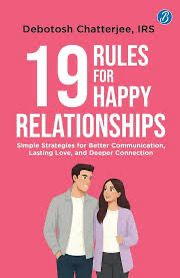
19 Rules of Happy Relationship by Debotosh Chatterjee— A Thoughtful Reality Check on Love, Compatibility & Emotional Maturity
Relationships are often sold to us as magical, effortless, and emotionally consuming experiences. But in reality, relationships are layered, complicated, deeply personal, and sometimes overwhelming. In 19 Rules of Happy Relationship, Debotosh Chatterjee attempts to decode these complexities with practicality and emotional honesty. Rather than glorifying romance, the book brings readers face-to-face with the quieter realities that actually sustain or destroy relationships over time.
One of the strongest aspects of the book is how it challenges fantasy-driven ideas of love. The author repeatedly highlights how decisions made out of loneliness, emotional overwhelm, social pressure, or FOMO can later become difficult burdens as individuals evolve with time. The book does not dismiss love, but it questions whether emotional intensity alone is enough to build a stable partnership. Through multiple observations and examples, the author emphasizes that compatibility is not built merely on attraction, but on maturity, adaptability, shared understanding, and realistic expectations.
Another compelling discussion in the book revolves around inherited relationship beliefs. The author explains how childhood experiences, parental relationships, and teenage emotional conditioning silently shape our understanding of love and commitment. Many people unknowingly carry borrowed expectations into adulthood, only to later realize that rigid ideas about relationships can become limiting or emotionally unhealthy. Through stories and examples, the book encourages readers to develop emotional flexibility instead of blindly replicating patterns they grew up witnessing.
A major recurring theme throughout the book is self-awareness. Before understanding a partner, the author argues that one must first understand oneself including lifestyle choices, value systems, food habits, professional ambitions, cultural upbringing, emotional capabilities, and long-term goals. This perspective makes the book feel far more grounded than conventional relationship advice books. It repeatedly reminds readers that relationships are not isolated emotional experiences; they exist within routines, families, careers, habits, and personal belief systems.
The discussion around value systems particularly stands out. The author explains that the true nature of a relationship begins to reveal itself when two different value systems collide. Integrity, accountability, honesty, reliability, and behavioral patterns slowly become visible through everyday decisions and reactions. The book suggests that compatibility is often reflected less through romantic gestures and more through consistency, responsibility, empathy, and mutual respect.
Another thoughtful aspect of the book is its focus on balance. Love, according to the author, is subjective, and no two individuals experience or express it in identical ways. Because of this, finding a midpoint becomes essential for sustaining relationships. Silent goals, emotional boundaries, trust, empathy, and reliability are repeatedly emphasized as foundational pillars of healthy partnerships. The author frames relationships not as perfect unions, but as evolving spaces that require conscious effort and emotional awareness from both people involved.
The book also moves into psychological territory with its discussion of “Nice Person Syndrome.” This section explores people-pleasing behavior, emotional self-erasure, manipulation, and toxic relational dynamics. The author carefully distinguishes kindness from passivity and provides practical insights into avoiding becoming a pushover or falling prey to manipulative personalities. This chapter adds another layer of realism to the book, making it relevant not just for romantic relationships, but for understanding human dynamics in general.
One of the more mature elements of the book is its willingness to discuss monotony, emotional fatigue, and even the death of relationships. Instead of presenting relationships as endlessly exciting, the author acknowledges that phases of boredom, conflict, emotional distance, and discomfort naturally emerge over time. Words, actions, life events, and unresolved patterns can slowly challenge the foundation of a partnership. The book emphasizes that these phases require active correction, accountability, communication, and mutual effort rather than passive expectation.
What makes 19 Rules of Happy Relationship particularly grounded is that it does not romanticize permanence at all costs. The author openly acknowledges that despite effort and emotional investment, some relationships may still reach an expiry point. In such situations, establishing healthy boundaries becomes an act of emotional self-preservation rather than failure. The discussion around peer pressure, emotional dependency, and externally influenced decisions adds further depth to the book’s realistic outlook on modern relationships.
Overall, 19 Rules of Happy Relationship is less about offering fairy-tale romance advice and more about encouraging emotional maturity, self-awareness, discernment, and conscious relationship-building. It explores both the beauty and the complexity of human connection while acknowledging the emotional, behavioral, and practical realities that shape relationships over time. Thoughtful, analytical, and deeply reflective, this book serves as a detailed exploration of the many layers that exist beneath love itself.